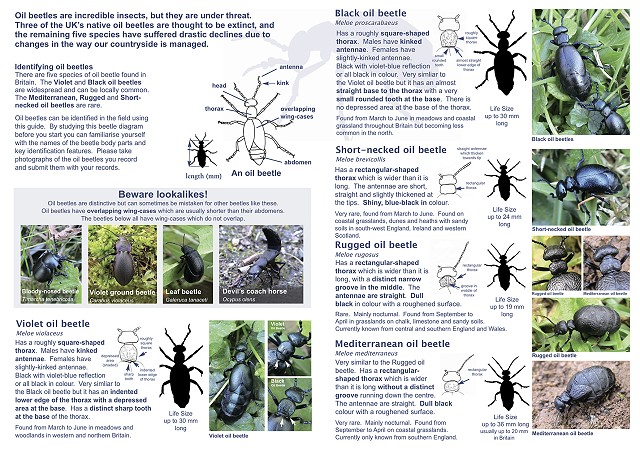
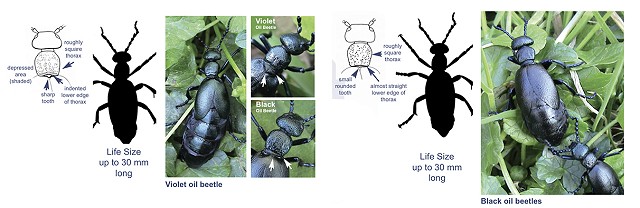
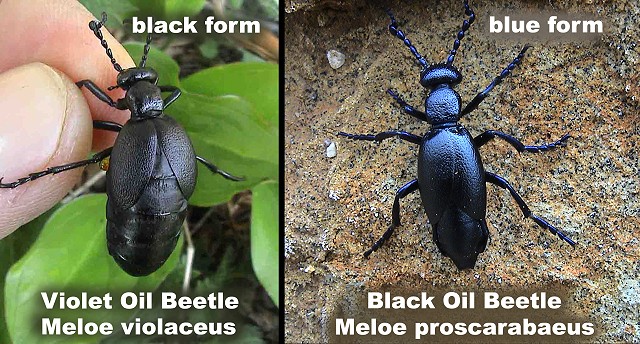
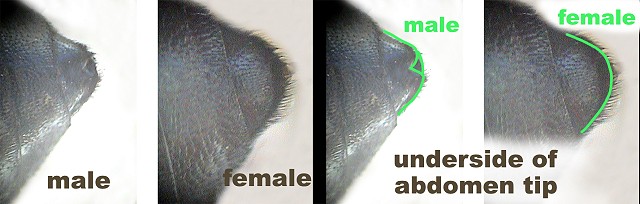
These beetles are named after their ability to produce a bitter oil-like fluid from their knee joints when disturbed - this deters most predators. They have a very unusual life history. The adult beetles mate soon after emergence. In the Violet and Black Oil beetles the males have kinked antennae which are used to grab on to the female’s antennae during courtship. Once mated the pair remain together for over an hour during which time the male is dragged along behind the female wherever she goes. Watch a video of Black Oil Beetle courtship here.
A few weeks after mating the female digs a short burrow in the soil into which she lays a batch of about 1000 eggs before covering the entrance with soil. In her lifetime (about 2 months) a female may lay up to 40, 000 eggs.
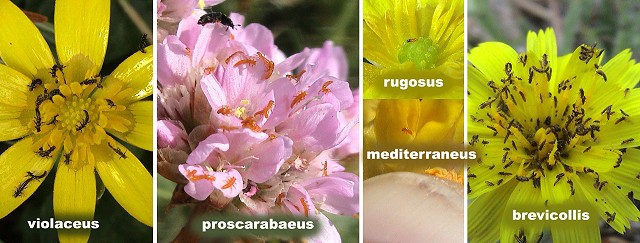
When the eggs emerge the larvae, known as triungulins (they have 3 hooks on each foot) climb up vegetation and sit on flowers. They lie in wait before attaching themselves to any insects which visit the flower. The few that survive are those taken back to the nests of solitary mining bees. Often the bee tries to remove the triungulins see video here of a Short-fringed Mining Bee Andrena dorsata https://www.youtube.com/watch?v=lLRV8M0v25Y Once in a solitary bee nest the triungulin disembarks and consumes the egg and pollen supply of the host bee. It then pupates and emerges as an adult the following year. The triungulins of the UK species vary from 0.5 - 2.5 mm long but are fairly easy to identify under a microscope. See guide below, the Violet and Black Oil Beetles have the largest most visible triungulins, note that the Violet Oil Beetle triungulins in Scotland (and formerly in south-east England) are yellow not black so can only be told from Black Oil Beetle triungulins by their size being over 2 mm. The Violet Oil Beetle has a two-year life cycle and the adults and triungulins of the different generations can be seen together in the spring, the other species have annual life cycles and their triungulins can be found from spring to summer.
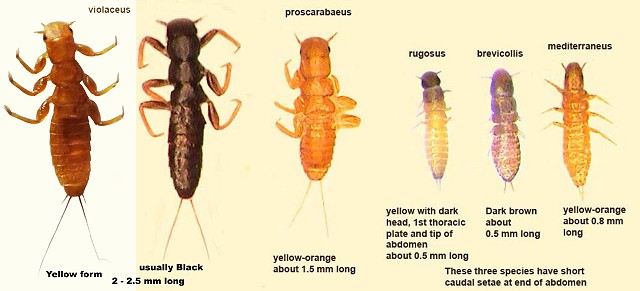
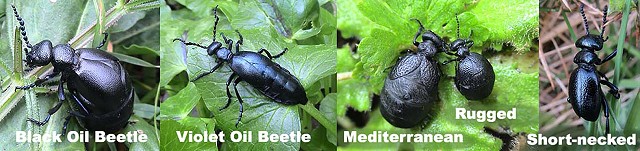
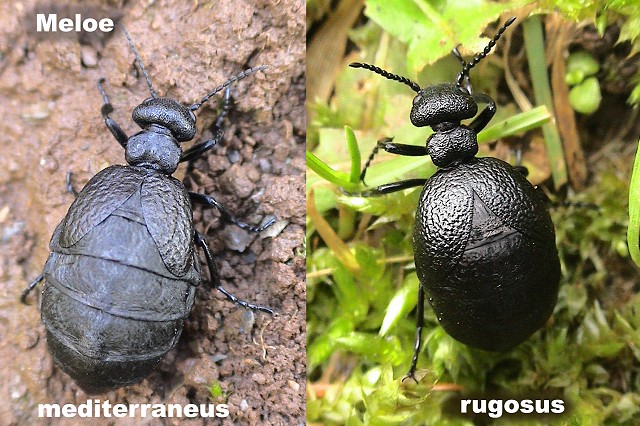
Most oil beetles are active in the spring and early summer and can be found where solitary bees abound in meadows, coastal grasslands and woodland glades. The adults are active on sunny days and feed on the leaves and flowers of a number of plants including celandines, buttercups and dandelions. The Rugged and Mediterranean Oil Beetles differ from the others by being active during the late autumn and winter and are mainly nocturnal. They are very similar in appearance. The Rugged Oil Beetle is usually 10 - 15 mm long and has a thin impressed furrow down the middle of the thorax. It is found in chalk and limestone areas. The Mediterranean Oil Beetle is usually 15 - 20 mm long slightly duller in appearance and lacks the thin impressed furrow on the thorax. It is currently known from two sites on the south coast of England in East Sussex and Devon but was formerly found in Kent and Essex so could be more widespread. Searching coastal sites at night in the autumn and early winter where large numbers of solitary bees are known to nest may lead to the discovery of new populations.
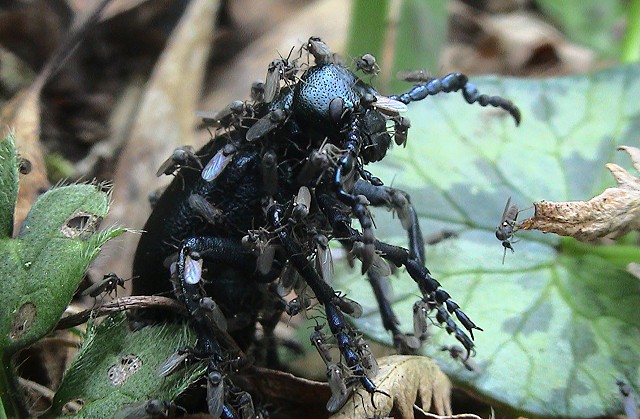
Oil beetles often attract small midges which feed on the oil produced by the beetle but do it no harm.